
*This post may contain affiliate links for which I earn commissions.*
Vampires have haunted our stories for thousands of years. Their roots stretch way back, long before Dracula ever bared his fangs in books or movies.
These creatures started out as terrifying beings in ancient myths and folklore. People invented them from deep fears about death, disease, and the unknown.
From Mesopotamian demons who drank blood to Eastern European legends of the undead rising from graves, vampire stories have shaped how cultures understand mortality and the supernatural.
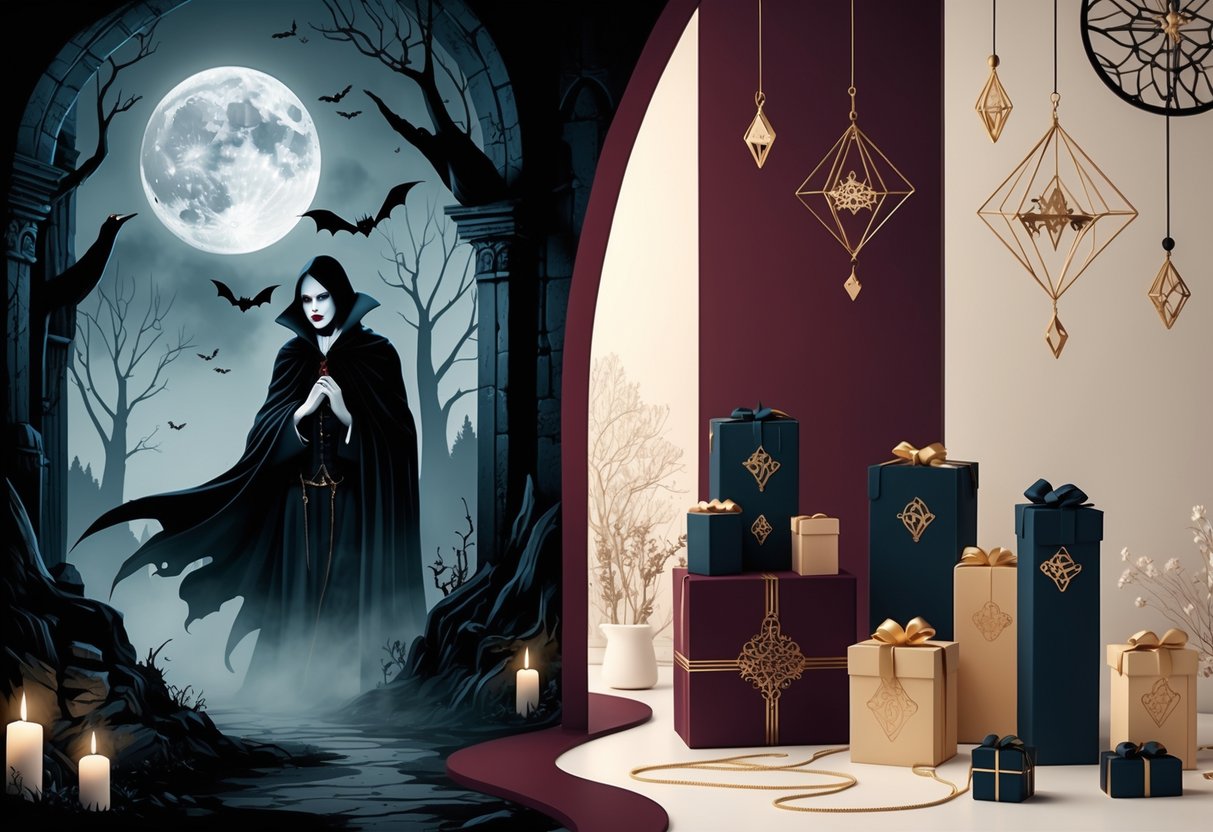
The vampire myth has evolved from ancient folklore into a modern icon. Now, it influences everything from Halloween decorations to jewelry design, transforming symbols of fear into objects of fascination and style, a shift you’ll also see in Christmas horror gifts made for vampire devotees.
What started as protective rituals against evil spirits has become a rich source of creative inspiration for artists and designers. It’s wild how these old symbols of dread now show up everywhere, even in chic boutiques.
I remember wandering through a tiny vintage shop once, half expecting dust and gloom, and instead finding a dainty little necklace with a single fang charm sitting in a glass case like it was fine jewelry.
I caught myself smiling because my brain flashed to all those old stories about people using charms to ward off the dead. Seeing that fear turned into something pretty and wearable made the whole vampire obsession feel weirdly human, and kind of sweet.
Let’s wander through the dark history of vampire beliefs. I’ll show you how ancient fears shape the vampire-themed gifts and products we love today.
If you want a modern, everyday example of that vibe, these gifts for vampire girls who hate hectic mornings fit the mood perfectly.
We’ll look at how garlic, crosses, and fangs went from serious protective charms to playful design elements. These symbols now celebrate our ongoing obsession with these mysterious creatures.
The Ancient Roots of the Vampire Myth
Vampire legends didn’t start with Dracula or even medieval Europe. Ancient civilizations all over the world had their own versions of blood-drinking creatures and undead spirits.
A lot of these monsters came from a mix of real medical conditions and supernatural fears. It’s hard to blame people for making up stories when they didn’t have science to explain things.
Vampiric Creatures in Ancient Greece and Rome
Ancient Greece gave us some of the earliest vampire-like figures. Greek mythology included creatures like Lamia, a woman cursed by Hera and transformed into a child-eating demon who drank blood.
The story goes that Zeus’s jealous wife drove Lamia mad after discovering her affair with Zeus, turning her into a monster. That’s some serious drama.
Empusa was another vampiric being from Greek folklore. She seduced young men at night and drank their blood while they slept.
These creatures often appeared as beautiful women who hid monstrous forms. It’s a theme that still pops up in vampire tales today.
The Romans had their own fears. They dreaded the Strix, a bird-like creature that ate human flesh and drank blood.
Roman writers described protective rituals against these beings, like using certain herbs and prayers. People really didn’t mess around with this stuff.
These ancient stories share traits with modern vampire myths. Blood-drinking, shapeshifting, and hunting at night sounds familiar, right?
Blood and Spirit Beliefs Across Cultures
Blood meant a lot in ancient societies, not just in Greece and Rome. Many cultures believed blood carried a person’s life force or spirit.
This idea made blood-drinking creatures especially terrifying. Losing blood wasn’t just gross. It meant losing your soul.
Ancient Mesopotamia had Lamashtu, a demon that preyed on pregnant women and infants. Not exactly bedtime story material.
Egypt’s goddess Sekhmet was famous for her bloodlust during battle. In India, the Vetala were spirits that lived in corpses and terrorized the living.
Some of these beliefs tied into religious practices. Ancient rituals sometimes involved blood offerings to gods or ancestors.
The idea that supernatural beings craved blood wasn’t always about evil. Sometimes, it was about transferring life energy from one being to another.
Disease and Misunderstanding as Origins
Real medical conditions probably kicked off a lot of vampire legends. Porphyria, a rare blood disorder, causes extreme sensitivity to sunlight and can make gums recede, giving people a fang-like look.
Victims sometimes craved blood because of severe anemia. That’s got to be unsettling to witness, especially in a small village.
Tuberculosis epidemics in the 18th and 19th centuries led to vampire hysteria. When one person died of TB, others would waste away too.
People didn’t understand contagious disease, so they blamed vampires. It’s a classic case of looking for a supernatural scapegoat.
Rabies fits the vampire profile, too. Infected people become sensitive to light, act aggressively, and sometimes bite others.
The plague made things weirder. Bodies would bloat and blood sometimes seeped from the mouth, making corpses look suspiciously lifelike.
Gravediggers would find bodies in strange positions and think the dead had been feeding. Normal decomposition got mistaken for evidence of vampirism.
Eastern European Folklore and the Rise of the Undead
The vampire legends we know best trace back to Eastern European folklore. Beliefs about the undead grew out of Slavic traditions, burial customs, and, honestly, some pretty wild historical events.
Communities in places like Romania and Transylvania created elaborate rituals to keep the dead from rising. Figures like Vlad the Impaler got tangled up with these supernatural tales.
The Slavic Upir and Vampir Legends
The Slavic people came up with some of the earliest vampire myths in medieval times. They called these creatures upir or vampir and believed they were restless souls who snuck out of graves at night.
These undead didn’t look like the romantic vampires we see in movies. Early Slavic vampires often appeared as bloated corpses with blood on their mouths.
They spread disease through villages and fed on blood or life force. Not exactly someone you’d want to run into after dark.
The strigoi of Romania were among the most feared vampires in Eastern Europe. Locals thought strigoi could be living witches or undead spirits.
The earliest written record of strigoi comes from the 11th century. A monk named Eraclius described these creatures lurking in the Carpathian Mountains.
Different regions had their own spins on the vampire myth. Some thought vampires came from people who died violently. Others said anyone buried improperly could become vampir.
These beliefs shaped how villages handled death and burial for centuries.
Funeral Rites and Vampire Prevention
Medieval Slavic communities took vampire prevention seriously. It’s almost impressive how much effort people put into keeping the dead from coming back.
Families put garlic in coffins and around graves to keep evil spirits away. Holy symbols like crosses showed up near burial sites.
Some villages buried suspected vampires face down, hoping they’d dig deeper into the earth instead of clawing their way out.
Other protective tricks included:
- Placing stones or coins on the eyes of the dead
- Driving stakes through the heart before burial
- Cutting tendons in the legs so the corpse couldn’t walk
- Burying bodies at crossroads to confuse spirits
Religious rituals played a big part. Priests performed blessings to help souls find peace.
Communities that skipped proper funeral rites risked making a vampire, or so they thought. This fear kept traditional burial customs going for generations.
Vlad the Impaler and Historical Figures
Vlad III of Wallachia, better known as Vlad the Impaler, ruled in the 15th century in what’s now Romania. He earned his nickname by impaling enemies on wooden stakes.
Vlad wasn’t a vampire, but his cruelty became tangled up with vampire legends. He ruled near Transylvania, a region already thick with undead folklore.
His castle at Poenari and the famous Bran Castle are now tourist hotspots tied to vampire myths.
Vlad’s father belonged to the Order of the Dragon, and “Dracula” means “son of the dragon” in Romanian. Bram Stoker drew inspiration from this for his 1897 novel.
The historical Vlad died in 1476. Over time, his bloody reputation merged with local vampire beliefs.
Disease and the Spread of Panic
Medical conditions fueled vampire hysteria across Eastern Europe. Tuberculosis made people pale, caused them to cough up blood, and waste away.
Villagers saw these symptoms and thought vampires were to blame. The plague outbreaks in the 18th century made fears worse.
When disease hit a village, people looked for supernatural causes. They blamed unexplained deaths on vampires feeding at night.
Decomposition only confused things further. Bloated bodies with blood near the mouth seemed like proof.
In 1725, villagers in Medveja dug up a man named Jovan, claiming his bloody mouth proved he was preying on the living.
With little medical knowledge, communities turned to folklore for answers. Crop failures and livestock deaths also got pinned on vampire activity.
From Folklore to Fiction: The Evolution of Vampire Lore
The vampire myth shifted from ancient folklore to literary fiction in the early 1800s. Writers like John Polidori, Bram Stoker, and Mary Shelley turned the vampire into a sophisticated character.
John Polidori’s The Vampyre and Lord Ruthven
In 1819, John Polidori published The Vampyre. This story gave English readers their first aristocratic vampire, Lord Ruthven.
He wasn’t like the mindless corpses from old tales. Lord Ruthven was charming, wealthy, and moved through high society.
Polidori wrote the story after that famous night at Villa Diodati in 1816, the same one that sparked Mary Shelley’s Frankenstein. Lord Byron started a vampire story that night, but Polidori finished it in his own way.
Lord Ruthven changed vampire mythology. He was clever and used his social status to get close to victims.
This was a big shift from the grave-roaming ghouls of folklore. The story became a hit across Europe.
It set the stage for almost every vampire character that followed, from Dracula to the modern vamps in books and movies.
Bram Stoker’s Dracula and Gothic Literature
Bram Stoker published Dracula in 1897. This book pulled together all the scattered pieces of vampire lore into one unforgettable myth.
Stoker partly based his character on Vlad the Impaler. But Dracula was more than a historical figure. He had powers and weaknesses that became standard.
He could turn into a bat or wolf, couldn’t enter homes without permission, and feared crosses, garlic, and sunlight.
The novel dripped with Gothic style. Dark castles, mysterious foreigners, and the threat of corruption spreading to England set the mood.
Stoker wrote the book as letters and journal entries. That format made the horror feel intimate and real.
Dracula gave us rules for vampires that writers still use. The idea of vampires creating more vampires through biting? That’s from Stoker.
The romantic and sexual tension between vampire and victim also really took off here. If your taste leans literary and a little bloodstained, dark academia gifts for bookworms who like their classics on the dangerous side are a natural next stop.
Mary Shelley and the Origins of Gothic Monsters
Mary Shelley wrote Frankenstein in 1818, just before Polidori’s The Vampyre. Her novel focused on a reanimated corpse, not a vampire, but she helped create the Gothic monster genre.
Shelley was only 18 when she came up with the story at Villa Diodati. Her creature had feelings, thoughts, and reasons for his actions.
This approach influenced how later writers handled vampires. They became more than simple evil creatures. They had motivations and personalities.
Gothic literature under Shelley’s influence explored death, immortality, and what it means to be human.
Her work proved horror stories could be serious literature. That opened the door for writers like Stoker to publish vampire novels that critics would actually take seriously.
Vampires in Modern Fiction and Popular Culture
Modern vampire fiction turned these creatures from terrifying monsters into complex characters. Now, they explore themes of immortality, morality, and forbidden love.
From Anne Rice’s philosophical immortals to sparkly romantic heroes, vampires have become some of the most recognizable figures in pop culture.
Anne Rice and the Vampire Chronicles
Anne Rice changed the vampire genre in 1976 with Interview with the Vampire. She made vampires the heroes of their own stories, not just the villains.
The novel introduced Louis, a guilt-ridden vampire struggling with immortality, and Lestat, his unapologetic maker.
These weren’t just monsters. They had real feelings, regrets, and desires.
Rice’s vampires wrestle with meaning, loneliness, and what it means to be human. They form relationships, create families, and search for purpose across centuries.
This approach influenced a whole new generation of writers and filmmakers.
The 1994 film adaptation brought these characters to the mainstream. Suddenly, vampires were tragic, sympathetic figures, almost relatable, in a strange way.
Twilight Saga and Romantic Vampires
The Twilight saga by Stephenie Meyer shook up the vampire world in 2005. Suddenly, vampires could sparkle in sunlight, go to high school, and fall for humans.
Meyer’s take made vampires feel safe and romantic, not just scary. The story centers on Bella Swan and Edward Cullen, a vampire who tries (and often fails) to resist her scent.
Critics said Twilight took the bite out of vampire tales. Fans loved how it opened the genre to younger readers.
Like it or not, the books sold millions and the five movies became a pop culture storm. The series also inspired a wave of supernatural romance and changed how publishers marketed vampire fiction.
Buffy the Vampire Slayer and Television
Buffy the Vampire Slayer hit TV in 1997 and ran for seven seasons. The show followed Buffy, a high school girl chosen to fight vampires and all sorts of supernatural weirdness.
Joss Whedon, the creator, used vampires as stand-ins for real-life struggles like bad relationships, addiction, and the messiness of growing up. Some vampires, like Angel and Spike, actually wrestled with their own dark sides.
Buffy proved vampire stories could be funny, sad, and full of action all at once. It helped pave the way for shows like True Blood, where vampires lived openly and faced prejudice.
Cinematic Icons: Nosferatu and Bela Lugosi
Nosferatu (1922) gave us Count Orlok, one of the first movie vampires. He looked more like a corpse than a person, with pointed ears and creepy fingers.
In 1931, Bela Lugosi changed the game with his version of Dracula. Suddenly, vampires were charming, sophisticated, and even a little sexy. Lugosi’s accent, cape, and style set the standard for decades.
Key differences between these portrayals:
- Count Orlok: Gross, rat-like, pure monster
- Bela Lugosi’s Dracula: Suave, classy, strangely attractive
Those early films set up the look and feel of vampires that still stick around today. Lugosi’s mix of horror and allure shaped every vampire performance that followed.
For a wider look at how horror characters become collectible style, this beginner guide to horror icons and their merch legacies is the perfect side quest.
Symbolism and Themes Within the Vampire Myth
Vampires are loaded with symbolism. They tap into our deepest fears about sex, death, and crossing lines society says we shouldn’t. That same push-pull is exactly why horror aesthetics feel so good in our decor.
These creatures reflect our anxieties and secret longings, from the fear of disease to the fantasy of living forever.
Sexuality and Forbidden Desires
Vampires have always had a sexy side. The neck bite is intimate, almost too close for comfort, and it’s hard not to see the parallels to sex.
Old folklore often had vampires sneaking into bedrooms and targeting former lovers. That tied them to temptation and adultery.
Victorian books like “Dracula” used vampires to talk about sexuality at a time when nobody else did. The bite is both a violation and a seduction, pleasure mixed with terror.
Key Sexual Themes:
- Penetration and sharing bodily fluids
- Nighttime bedroom visits
- Changing someone through intimate contact
- Power games between hunter and prey
Immortality and Fear of Death
Vampires make us face our weird relationship with death. They live forever, but it’s not all it’s cracked up to be.
They have to kill to keep going and can’t really join in with regular life. Vampires stay the same while everyone they care about grows old and dies.
Their undead state messes with religious ideas about what happens after we die. They’re stuck between life and death, almost mocking the idea of peaceful rest.
People in the past took wild measures to keep the dead from coming back. Stones on graves, coins on eyes, stakes through hearts, all signs of how much the idea scared everyone.
Disease, Otherness, and Societal Fears
A lot of vampire myths started because people didn’t get how bodies decompose. Someone would see a swollen corpse with blood at the mouth and panic about vampires.
Plagues in medieval Europe made things worse. When diseases like tuberculosis or rabies ripped through towns, folks sometimes blamed vampires instead of germs.
Vampires also stood for outsiders. In “Dracula,” the count comes from Eastern Europe and threatens English society, feeding into fears of foreigners.
The way vampires blend in but stay different made them a handy symbol for anyone seen as “other.”
Diseases Linked to Vampire Myths:
- Tuberculosis (pale, thin victims)
- Rabies (aggression, fear of water)
- Porphyria (sensitivity to sunlight)
- Premature burial (scratch marks inside coffins)
How Vampire Lore Shapes Modern Gift Design
Vampire vibes have crept from old legends into everyday stuff, especially gifts. Dracula, bats, and all things undead now show up on jewelry, home decor, and even coffee mugs.
And if you’re building a full vampire-themed present instead of one item, this horror gift-box guide shows how to bundle it with style.
Popular Vampire Motifs in Gift Items
Vampire-themed gifts are everywhere these days. Fangs, coffins, and Gothic crosses are probably the top picks.
Blood drops and bite marks pop up on jewelry, shirts, and even phone cases.
Common vampire gift motifs include:
- Fang necklaces and earrings
- Bat wing accessories
- Coffin-shaped boxes and bags
- Red and black color combos
- Victorian cameos with vampire faces
Thanks to modern vampire stories, these symbols feel more cool than creepy. Velvet, lace, and dark metals give gifts a mysterious edge.
Bat designs are especially popular. I see bats on everything, pins, pillows, you name it. Bats tie straight into vampire lore and add a bit of spookiness without going overboard.
Influence of Dracula and Victorian Horror
Dracula made a huge mark on how we think about vampire gifts. Bram Stoker’s character brought a touch of class to the monster story.
A lot of gift items riff on Victorian style, with ornate frames, fancy fonts, and old-school details. Cameo brooches, pocket watches, and wax seals all nod to that era.
The romantic side of vampires matters too. Many gifts lean into the seductive, mysterious vibe rather than just horror.
You’ll see it in perfume bottles shaped like potion vials or candles that smell like “ancient libraries.”
Victorian vampire elements in modern gifts:
| Design Element | Common Applications |
|---|---|
| Ornate frames | Mirrors, picture frames, wall art |
| Gothic lettering | Greeting cards, journals, prints |
| Red velvet | Jewelry boxes, bags, clothing |
| Antique gold/silver | Jewelry, decorative objects |
From Bats to Blood: Modern Aesthetic Trends
The vampire look has gotten more daring lately. Blood imagery is everywhere, from red resin jewelry to wine glasses with etched drips to bath stuff in deep crimson.
Bats have gone from scary to downright cute. Designers make bat characters with big eyes and friendly faces now.
Minimalist vampire designs are catching on too. Simple fang outlines or single bat silhouettes look good on totes, mugs, and phone cases.
Deep purples, blood reds, and black rule the color choices. A bit of silver or gunmetal adds a supernatural touch.
Pop culture vampires have taught designers that vampire gifts can be stylish and fun, not just spooky.
Frequently Asked Questions
Vampire myths come from a mashup of misunderstood diseases, social fears, and folklore that traveled across continents for centuries. Those old stories still shape horror tales and the gothic style you see in modern products.